Rapid Prototype for a Muscle Stimulation Rig


A single-board RIO, nine serial receivers in the FPGA and less than a week of work — from a box of loose wires to a working muscle-stimulation rig with capture and export.
A single-board RIO, nine serial receivers in the FPGA and less than a week of work — from a box of loose wires to a working muscle-stimulation rig with capture and export.
Several years ago a customer arrived at the office with a box and a handful of wires sticking out of it. He had an idea: a device that would stimulate muscle tissue with electricity and then use acceleration sensors to measure the response. He had already selected and bought the sensors.
The concept was simple — stimulate a muscle, gather accelerometer data, and align that data with the experiment. Each sensor exposed four lines: V+ for power, GND for ground, TX for the data the sensor transmits, and RX for commands and configuration.
He wanted to start immediately, so I picked up a single-board RIO from National Instruments, connected power and ground along with the TX and RX lines, and implemented a serial interface in the FPGA. To save time I copied the FPGA receiver block nine times, and very soon we had synchronised data flowing from all the sensors.
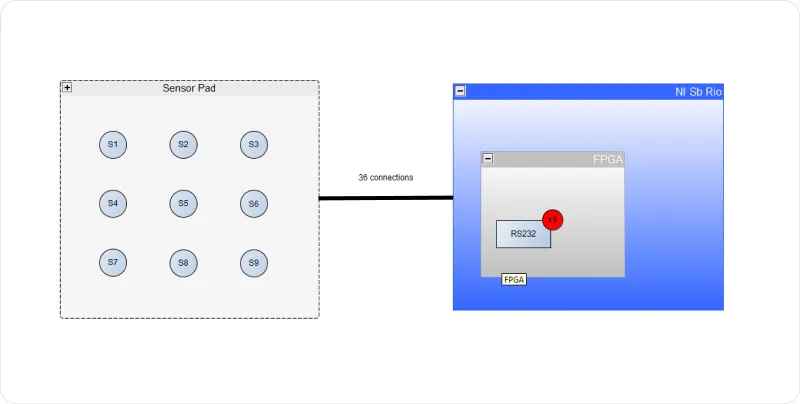
With some debugging and a little development we had a control panel that triggered the stimulating event and captured data into a file for a configurable amount of time. Within a few more hours there was a simple application with a GUI that could plot and display the gathered data, export it to CSV or Excel, and support further analysis.
This was a straightforward proof of concept, and it took less than a week to complete with a little back and forth. The customer was happy, and his idea was brought to life in very short order.
Sometimes the key is knowing when to set the process aside and build something in a Mythbusters kind of way. That project was not particularly complex, but I still remember it fondly — it was fun, and it delivered something of real value to the customer.

Tell us what you're building and the constraints it has to work within, and we'll come back with an honest view of whether we're the right fit.